In modern electrical and electronic systems, switches play a vital role in controlling power, signals, and operating modes. Among the many types of switches available, the toggle switch stands out for its simplicity, durability, and clear mechanical operation. From industrial machinery and automotive dashboards to household appliances and electronic devices, toggle switches remain a trusted solution for manual circuit control.
WHAT ARE TOGGLE SWITCHES?
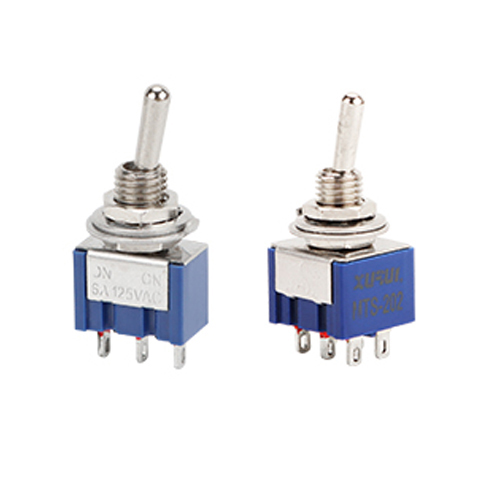
A toggle switch controls circuits by flipping a lever between fixed positions. It is a latching device, retaining state without continuous pressure, unlike momentary switches (e.g., pushbuttons).
Common configurations include SPST, SPDT, DPST and DPDT, differentiated by poles (circuits controlled) and throws (positions). They vary in voltage/current ratings, materials and actuation force for diverse applications.
HOW DOES A TOGGLE SWITCH WORK?
At the heart of a toggle switch lies a straightforward yet reliable mechanism, composed of three key components: an externally accessible toggle lever (the user-operated actuator), conductive electrical contacts, and a spring-loaded latching structure that secures the switch’s position.
1. Off State: In its default resting position, the toggle lever keeps the movable electrical contacts separated from the fixed contacts. This separation creates an open circuit, effectively blocking the flow of electrical current from the power source to the connected load (such as a light or motor).
2. Actuation: When the user manually flips the toggle lever to the desired position (typically "on"), the lever’s mechanical movement pushes the movable contacts into firm contact with the fixed contacts. This closes the circuit, enabling a steady flow of current that activates the connected load.
3. Latching: The integrated spring mechanism plays a crucial role here—it snaps the toggle lever into a fixed position once actuated, ensuring the switch maintains its current state (on or off) without requiring continuous user pressure.
For multi-position variants like SPDT (Single Pole, Double Throw) or DPDT (Double Pole, Double Throw) toggle switches, the lever shifts between additional sets of fixed contacts, redirecting electrical current to different circuits as needed.
WHAT ARE TOGGLE SWITCHES USED FOR?
Due to their reliability and clear status indication, toggle switches are used in a wide variety of industries and environments:
Industrial equipment: machine controls, power isolation, function selection
Automotive applications: lighting systems, fans, auxiliary devices
Consumer electronics: power switches for audio and electronic products
Marine and outdoor systems: waterproof and sealed control switches
Electrical panels and appliances: circuit switching and safety control
Their physical switching position allows operators to instantly confirm whether a circuit is ON or OFF, which is critical in safety-sensitive applications.
PROS & CONS
Pros (Advantages)
Simplicity: Intuitive operation with clear markings, low user error.
Reliability: Fewer moving parts; high-quality models withstand thousands of actuations and harsh conditions.
Latching: Maintains state without continuous user input.
Versatility: Diverse configurations and ratings for simple to complex circuits.
Cost-effective: Inexpensive for mass production and low-budget projects.
Cons (Disadvantages)
Bulkiness: Less suitable for compact electronics vs. slide/micro switches.
Manual operation: Limits use in hands-free/remote control scenarios.
Accidental actuation: Protruding lever risks unintended state changes.
Limited features: No dimming/speed control; requires additional components for advanced functions.
Contact wear: High current use causes wear, arcing or failure over time.
Conclusion
Toggle switches continue to be a cornerstone of electrical and electronic design. Their robust construction, ease of use, and versatility make them ideal for applications ranging from basic power control to complex industrial systems. Despite the availability of newer switch technologies, toggle switches remain a dependable and widely used solution.
FAQ
Q1: What is a toggle switch used for?
A: Toggle switches are used to manually turn circuits on or off or switch between different electrical paths.
Q2: What does SPST or SPDT mean in toggle switches?
A: These terms refer to the number of circuits controlled and switching positions available.
Q3: Are toggle switches suitable for high-voltage or high-current applications?
A: Yes, as long as the switch is rated for the required voltage and current.
Q4: Can toggle switches be used outdoors?
A: Waterproof and sealed toggle switches are designed specifically for outdoor and harsh environments.
Q5: How do I select the right toggle switch?
A: Consider electrical rating, configuration, mounting method, environmental protection, and application requirements.