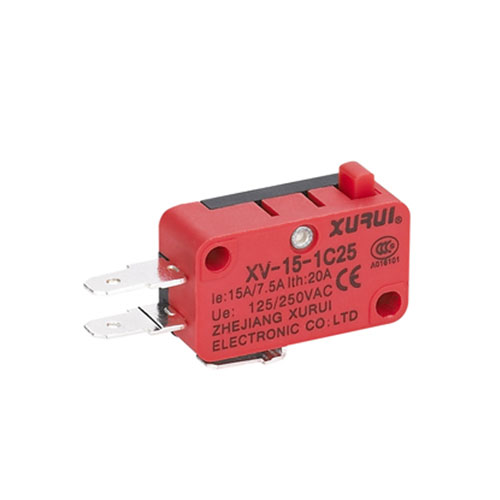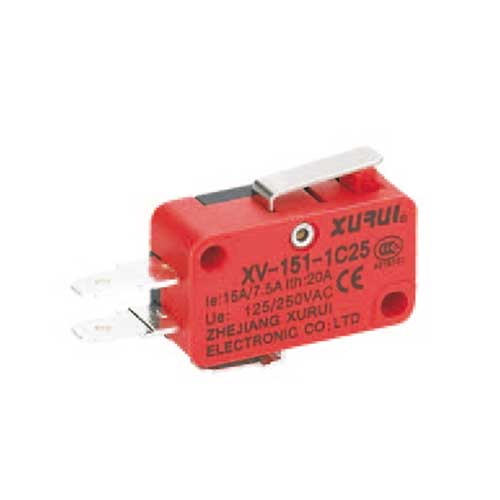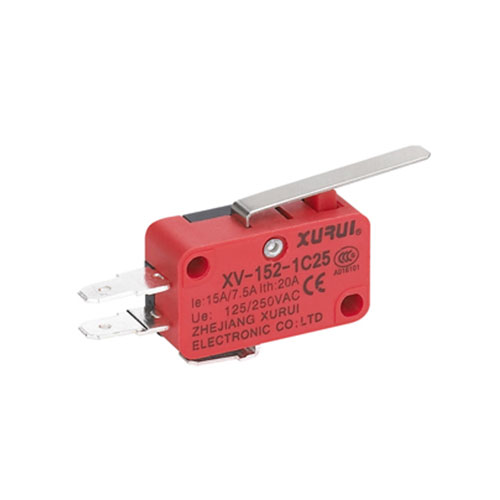
A packaging plant in Poland had a recurring problem with a conveyor that carried finished cartons to a palletizing robot. The end stop was a block of steel bolted to the frame. Every time the conveyor jogged in manual mode, the cartons would pile up against the stop, the belt would slip, and the shift supervisor would have to clear the jam. The limit switch at the end of the conveyor was a simple mechanical plunger that tripped only when the carton was already touching the steel stop — too late to prevent the pile‑up.
A limit switch with a different actuator and a longer pre‑travel changed the outcome. The new switch, a small vertical limit switch with a roller plunger actuator, was mounted so that the roller contacted the leading edge of the carton 3mm before the carton reached the steel stop. The switch triggered the PLC to stop the conveyor, and the carton coasted to a stop exactly at the end of the belt, with no pile‑up, no jam, and no supervisor intervention.
A limit switch is an electromechanical device that senses the presence or position of an object. When an object moves to a preset position, the actuator (plunger, lever, or roller) moves, which causes the internal contacts to change state — typically from normally open (NO) to closed, or from normally closed (NC) to open. The switch sends a signal to a PLC, relay, or controller, which then stops a motor, engages a brake, or moves to the next step in a sequence. The switch’s performance is defined by its electrical ratings (voltage and current), its mechanical life (number of cycles before wear), its ingress protection (IP rating for dust and water), and its actuator characteristics (pre‑travel, over‑travel, differential travel, and operating force). This article explains why the actuator type determines whether a conveyor stops before the stop or hits it, how the IP rating (IP65 vs IP66) changes where you can mount the switch, and where the 10A/250VAC rating fits into a control circuit.
Pre‑travel and over‑travel: why the distance from the actuator to the contact click matters more than the current rating
The pre‑travel (PT) is the distance the actuator moves from its free position until the contacts “snap over” — the point where the switch changes state. The over‑travel (OT) is the additional distance the actuator can move after the contacts have switched, without damaging the switch mechanism. For a conveyor end stop application, the switch must have enough pre‑travel to trigger before the object contacts the hard stop. If the pre‑travel is too short (e.g., 1mm), the actuator may not have moved far enough to change the contact state before the object slams into the stop.
A small vertical limit switch with a roller plunger actuator typically has a pre‑travel of 1.8mm (standard) or more, and an over‑travel of 3mm minimum. The roller reduces friction between the actuator and the moving object, so the switch trips smoothly even when the object is moving at high speed. For a conveyor belt running at 0.5 m/s, a 3mm pre‑travel gives the PLC 6 milliseconds to process the signal and stop the motor — enough time for a modern drive system.
| Actuator Type | Typical Pre‑Travel (PT) | Typical Over‑Travel (OT) | Best Application |
|---|---|---|---|
| Push plunger | 1.5‑2.0 mm | 3‑5 mm | Direct contact from moving object |
| Roller plunger | 1.8‑2.5 mm | 3‑5 mm | High‑speed, low‑friction contact |
| Roller lever | 15‑20° rotation | 30‑40° | Large‑travel applications |
| Adjustable rod lever | Variable | Variable | Custom trigger points |
Why the differential travel (DT) affects reset accuracy
The differential travel (DT), also called movement differential, is the distance the actuator must move back before the contacts reset to their original state. A small DT (e.g., 0.2mm) means the switch will reset almost immediately after the actuator is released; a large DT means the switch will stay in the tripped state even if the actuator moves back slightly. For a conveyor that reverses direction after tripping, a small DT ensures the switch resets quickly, so the PLC can start the conveyor in reverse without an extra reset signal. For a gate position sensor that must stay in the “open” state until the gate is fully closed, a larger DT is preferable.
The roller plunger type switch uses a sintered stainless steel roller that reduces friction, extends the life of the actuator, and prevents stiction that could cause the switch to stick in the tripped position. The roller is mounted on a hardened steel shaft and is sealed against dust ingress.
IP65 vs IP66: where you can mount the switch and where you cannot
A limit switch that fails because water enters the housing is a design error, not a component failure. The IP rating defines the degree of protection against dust and water. IP65 means the switch is dust‑tight (6) and protected against low‑pressure water jets from a nozzle (5). IP66 means the switch is dust‑tight (6) and protected against powerful water jets (6). For a conveyor in a dry indoor environment, IP65 is sufficient. For a switch mounted on an outdoor conveyor exposed to rain or on a machine that is pressure‑washed, IP66 is required.
The XZ5 series switch from XURUI is rated IP66 with a heavy‑duty zinc alloy housing, designed for harsh environments including marine, food processing, and chemical plants. The XZ-8 series offers IP65 protection with a reinforced metal base, suitable for most industrial automation applications. The XZ7 small limit switch also offers IP65, with oil‑resistant seals for machine tool applications where coolant mist is present.
The housing material also determines the environmental resistance. A plastic‑housed switch (XZ-93 series) is lightweight and offers good insulation but may crack under impact. A metal‑housed switch (XZ-8, XZ5, XZ7, XZ-9M) withstands higher impact forces and resists degradation from oil, solvents, and UV exposure. For an overhead crane application where the switch may be struck by swinging loads, a metal housing is mandatory.
Why the IP rating matters for the internal switch contacts
Water ingress does not cause an immediate failure. It wicks into the contact chamber, creates a conductive path between terminals, and causes intermittent false triggering or contact welding. A switch that works fine in dry conditions may fail after a rainstorm when moisture has had time to seep past the seals. The IP rating applies to the whole assembly, including the cable entry gland. If the installer uses a PG9 cable gland that is only IP54, the system IP rating drops to IP54, regardless of the switch’s rating. The cable gland must be selected to match the switch’s IP rating.
10A/250VAC contact rating: why a switch that switches 5A at 12V DC is not the same as one that switches 5A at 250V AC
The contact rating printed on a limit switch — e.g., “10A at 250VAC” — assumes a resistive load (heaters, incandescent lamps). Inductive loads (motors, solenoids, relays) generate an arc when the contacts open, which erodes the contact material faster. The manufacturer’s specification for AC‑15 (inductive load) is typically 3A at 240VAC for the same switch that is rated 10A at 250VAC resistive.
The current rating also changes with the operating voltage. A switch rated 10A at 250VAC may be rated only 0.27A at 250VDC because a DC arc does not self‑extinguish every half‑cycle. For a DC circuit, the current rating must be derated. For low‑voltage DC control circuits (24V DC, 5‑50mA), the rating is not current‑limited but contact resistance must be low enough to ensure reliable operation. A switch with silver‑plated contacts will maintain low contact resistance in low‑current circuits; a switch with gold‑plated contacts is preferred for circuits below 10mA to prevent oxidation from increasing contact resistance.
The XZ-93 series is rated AC-15 3A/240VAC and DC 0.27A/250VDC, with a plastic housing and dual‑circuit design (snap‑action and slow‑action contacts). For a high‑power control circuit (e.g., a 10A motor starter coil), the XZ-8 series or XZ5 series with 10A/250VAC rating is the correct choice.
The contact form is typically SPDT (single pole double throw), meaning the switch has a common terminal, a normally open terminal (NO), and a normally closed terminal (NC). The operator selects the normally open circuit when the switch should close on actuation, and the normally closed circuit when the switch should open on actuation.
How the contact material affects the operating force
The micro switch inside the limit switch uses a moving contact bridge that is actuated by the plunger. The contact material (fine silver, silver‑cadmium oxide, gold‑plated, etc.) determines the contact resistance and the arc erosion rate. The operating force required to open the contacts is determined by the spring tension, not the contact material. A switch with a light operating force (e.g., 4N) is used for applications where the moving object applies minimal force; a switch with a higher operating force (e.g., 17N) is used where accidental actuation from vibration must be prevented.
For a conveyor end stop application where the carton pushes against the actuator with low force, a switch with an operating force of 4‑8N is required. The roller plunger reduces the effective force needed because the rolling friction is lower than sliding friction. The actuator force can be calibrated by adjusting the position of the switch relative to the moving object.
Over 1,000,000 mechanical cycles: why the life rating matters for a switch that trips 30 times per minute
A limit switch on a high‑speed packaging machine may trip 20‑30 times per minute, 8 hours per day, 5 days per week. That is roughly 380,000 cycles per year. A switch rated for 200,000 electrical cycles will need replacement after six months. A switch rated for 1,000,000 mechanical cycles and 100,000 electrical cycles at rated load will last two to three years.
The electrical life rating (100,000 cycles at 10A/250VAC) is measured at the rated load and at the rated operating frequency (typically 30 operations per minute). If the switch is used to switch a low‑current signal (e.g., a PLC input at 5‑20mA DC), the electrical life extends to near the mechanical life (over 1,000,000 cycles). The failure mode changes from contact erosion to mechanical wear of the plunger or lever.
The XZ-8 series and XZ-9 series are both rated for over 1,000,000 mechanical cycles and 100,000 electrical cycles at rated load. The XZ-8 uses a metal base with a reinforced housing, and the XZ-9 uses a metal housing for superior impact resistance. For a heavy‑duty application such as an overhead crane limit, the XZ-9M metal version is preferred because it withstands the shock of the crane carriage hitting the switch. For a standard conveyor end stop, the XZ-8 or XZ7 is sufficient.
The roller lever actuator on the XZ7 series has a small contact gap and high sensitivity, providing quick response for fast‑moving conveyors. The roller is made of sintered stainless steel, which is harder than standard steel and resists wear from abrasive dust.
Actuator options: why a roller plunger works for a conveyor but a roller lever works for a gantry crane
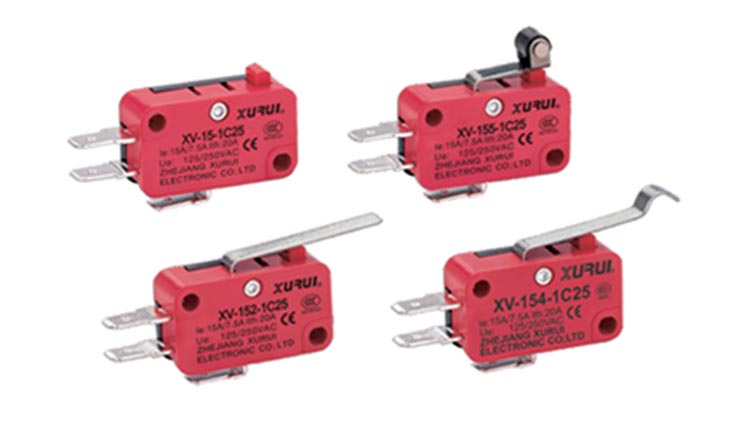
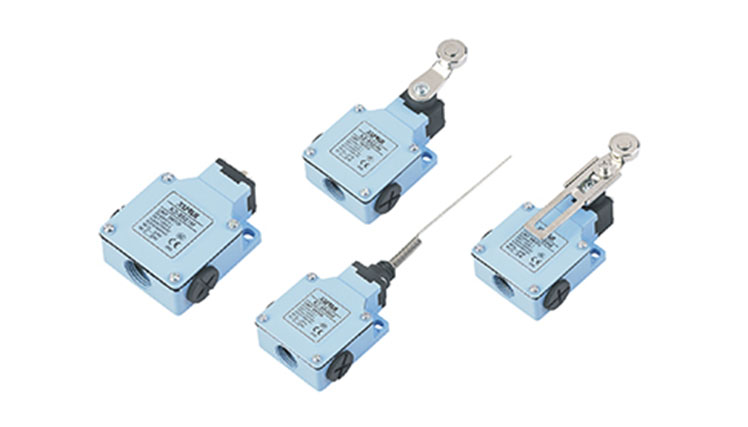
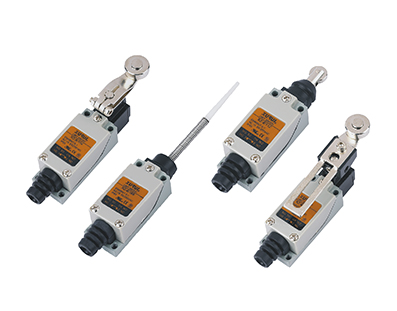
The actuator type determines how the switch is triggered. The small vertical limit switch is available in multiple actuator configurations:
-
Plunger (push plunger): The switch is triggered when a moving object pushes the plunger directly. Used when the object moves in a straight line toward the switch. Pre‑travel is short (1‑2mm). Operating force is higher (10‑20N) because the plunger must compress the return spring.
-
Roller plunger: A roller is mounted on the end of the plunger. The roller reduces friction and allows the switch to be triggered by an object moving tangentially (sideways) across the roller. Pre‑travel is slightly longer (1.8‑2.5mm). Operating force is lower (4‑8N) because the roller rolls, not slides.
-
Roller lever: A lever arm with a roller at the end. The lever rotates around a pivot when the roller is contacted. Pre‑travel is measured in degrees of rotation (15‑20°), not millimeters. Used when the moving object has a large travel distance or when the switch must be mounted away from the object’s path. The lever multiplies the force — the operating force at the roller is lower than the force at the plunger.
-
Adjustable rod lever: The lever arm length can be adjusted by sliding the roller along the rod. This changes the pre‑travel distance and operating force. Used for custom applications where the trigger point must be fine‑tuned after installation.
-
Spring rod (wire): A flexible wire spring that bends when contacted. Used for very light objects or where the moving object cannot push a rigid actuator without damage. The spring wire is replaceable.
For a conveyor belt moving cardboard cartons, the roller plunger is the best choice. The carton contacts the roller, the roller rolls down the side of the carton, and the plunger is pushed inward. The low friction prevents the carton from snagging or tearing. For a gantry crane where the carriage is heavy and the movement is slow, a roller lever with a long lever arm provides the mechanical advantage needed to actuate the switch even if the carriage misaligns slightly.
The actuator type is interchangeable on most limit switch bodies. The XZ-8 series offers roller arm, adjustable rod lever, push plunger, cross roller plunger, and spring rod types. The XZ7 series offers plunger, hinge roller lever, short lever, and long lever types.
How the small vertical limit switch fits into a control circuit
XURUI Electronics (Zhejiang XURUI Electronics Co., Ltd.) has manufactured limit switches, micro switches, and solid‑state relays for over 20 years. The small vertical limit switch series includes models with reinforced metal housing (XZ-8), compact metal housing (XZ7), micro metal housing (XZ-9M), and plastic housing for lower‑cost applications (XZ-93). The ratings cover 10A/250VAC (resistive) and 3A/240VAC (AC‑15 inductive). IP ratings range from IP65 to IP66, with IP20 available for indoor dry applications. The switches are certified with CE, TUV, and UL marks, meeting international safety standards for export to Europe and North America.
The XZ7 series small limit switch is designed for industrial automation, conveyor systems, robotics, CNC machines, elevators, and logistics equipment. It features an IP65 metal housing, 10A/250VAC rating, fast switching with a small contact gap and high sensitivity, and multiple actuator options (plunger, hinge roller lever, short lever, long lever). The mechanical life exceeds 1,000,000 cycles, and the electrical life at rated load is 100,000 cycles. The mounting is panel or side mounting with metric thread, and the terminal block accepts solid or stranded wire.
A limit switch that triggers 3mm before a hard stop, resets quickly after release, and survives 1,000,000 operations keeps a conveyor line running without jams, reduces maintenance calls, and prevents the damage caused by overtravel. For an automation engineer who has cleared one too many conveyor pile‑ups, the small vertical limit switch with a roller plunger, 10A contact rating, and IP65 sealing delivers the pre‑travel, differential travel, and mechanical life that a hard stop alone cannot provide.
【Request a quote from XURUI Electronics】
Contact XURUI with your required actuator type (roller plunger, roller lever, push plunger), IP rating (IP65 or IP66), and contact rating (10A or 3A) to receive a small vertical limit switch sample and a full datasheet with pre‑travel and over‑travel specifications.