You're designing a control panel for an industrial machine. Everything is specified—the PLC, the contactors, the wiring. Then you get to the manual control: the switch that the operator will flip dozens of times a shift, day after day. It seems like a small detail. But when that switch fails, the machine stops—and the operator is calling maintenance.
A toggle switch changes its state by manually flipping a lever, controlling the on/off of a device or switching between different functions. It plays an important role in various electronic and mechanical equipment. But not all toggle switches are built for the same duty cycle. Xurui Electronics has been manufacturing toggle switches and other industrial control products since 2002, with over 50 patents and certifications including UL, TUV, CE, CCC, and KC. This guide covers what makes a toggle switch reliable, where the XT Series fits, and what to look for when specifying switches for your next project.
More than just flip it
A toggle switch looks simple—flip the lever, change the state. But behind that simplicity is a range of configurations that determine where and how it can be used.
SPST to FPDT — pick the right one
The XT Series includes single-pole, double-pole, triple-pole, and four-pole options, supporting various switching functions such as SPST, SPDT, DPST, DPDT, TPST, TPDT, FPST, and FPDT. What does that mean for your application?
-
SPST (Single-Pole Single-Throw) — Simple on/off. One circuit, one switch.
-
SPDT (Single-Pole Double-Throw) — One input, two possible outputs. Switches between two circuits.
-
DPST/DPDT — Two circuits controlled by one lever. Common for 220V applications where both lines need switching.
-
TPST/TPDT — Three circuits. Used in three-phase equipment.
-
FPST/FPDT — Four circuits. For complex control panels where multiple signals need switching simultaneously.
The XT Series also supports switching modes including ON-OFF, ON-ON, ON-OFF-ON (center-off), and Auto Reset. The center-off option is useful when you need a neutral position—like a motor that can run forward, stop, or reverse.
The lever matters more than you think
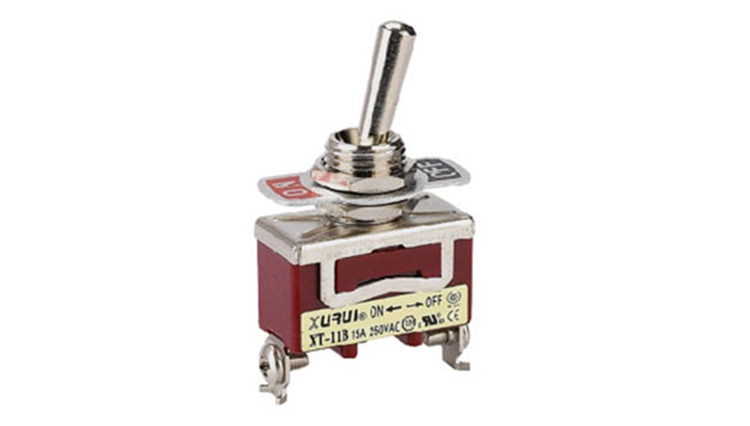
The toggle itself matters. Xurui's switches are engineered for reliability, durability, and versatility. The lever design affects how easily operators can flip the switch—even with gloves on. The panel-mount design uses an industry-standard 0.480-inch diameter mounting hole, simplifying panel layout.
That little cap makes a difference
Some XT Series models come with protective caps for improved water and dust resistance. In dirty or wet environments—machine shops, outdoor equipment, marine applications—that cap can be the difference between a switch that lasts for years and one that fails in months.
Stays reliable when it counts
A toggle switch that fails in the field costs more than the switch itself—it costs downtime, service calls, and frustrated customers.
500,000 flips before it wears out
Xurui's XT Series toggle switches are designed for durability. Mechanical life exceeds 500,000 cycles, with electrical life over 100,000 cycles at full load. For a switch that's flipped 100 times a day, that's over 13 years of mechanical life. For production equipment running 24/7, that's years of reliable service.
6A, 15A, 25A — know your load
The XT Series offers selectable contact ratings: 6A/125VAC, 15A/250VAC, 25A/250VAC, and more. The XT-13B model, for example, is rated at 15A 250VAC. That covers everything from low-power control circuits to higher-current motor loads.
UL, TUV, CE — not optional
Xurui's products are certified to ISO9001 Quality Management System and meet various standards including CCC, CE, TUV, UL, KC, and RoHS compliance. For equipment sold into regulated markets, these certifications aren't optional—they're required. A switch that isn't certified to the relevant standard creates liability for your equipment.
Below is a quick reference table for XT Series key specifications:
| Specification | XT Series | XT-13B (Example Model) |
|---|---|---|
| Contact rating | 6A/125VAC, 15A/250VAC, 25A/250VAC | 15A/250VAC, 25A/250VAC |
| Mechanical life | 500,000 cycles+ | 500,000+ |
| Electrical life | 100,000 cycles+ | 100,000+ |
| Operating temperature | -25°C to +80°C | -25°C to +80°C |
| Protection rating | IP40 (standard); protective cap option | IP40 |
| Insulation resistance | — | 100MΩ+ at DC500V |
| Contact resistance | — | 25mΩ |
| Terminals | Screw, solder, quick-connect | — |
Where they actually show up
Toggle switches are everywhere in industrial and commercial equipment. The XT Series is designed for a wide range of applications.
Machine tools and control panels
Machine tools, automation equipment, and power control systems all rely on manual switches for operator control. In a production environment, the switch needs to withstand thousands of operations without failure. The XT Series is built for this duty cycle.
Cars, boats, and the vibration they bring
Dashboards and control panels of vehicles and boats use toggle switches for lighting, heating, and signal indication. They're also suitable for fuel dispensers and EV chargers as power switches. In these applications, vibration resistance and reliable contact are critical.
Coffee makers to power saws
Fans, electric heaters, coffee machines, portable generators, and pet dryers all use toggle switches for power control. Power saws, drills, and other electric tools also rely on them. For consumer products, the switch needs to be cost-effective while still meeting safety standards.
Comms gear and medical devices
Intercoms, communication base stations, and power distribution boxes use toggle switches for precise circuit control. In medical equipment, high reliability is essential. For these applications, certifications like UL and CE matter—and Xurui's products are certified to both.
Three questions engineers always ask
Q: XT-A, XT-B, XT-C — what's the difference?
A: The XT Series includes multiple sub-series—XT-A, XT-B, XT-C, and others—each designed for different current ratings and applications. The XT-B Series is part of the broader XT family, which supports single-pole through four-pole configurations with switching functions from basic ON-OFF to Auto Reset. Contact Xurui with your specific voltage and current requirements for the right series recommendation.
Q: SPST or DPDT — which one do you actually need?
A: The number of poles determines how many circuits the switch controls. SPST controls one circuit (simple on/off). DPST controls two circuits (common for 220V applications). TPST controls three circuits (three-phase equipment). FPDT controls four circuits (complex control panels). If you're replacing an existing switch, match the pole count. If you're designing new equipment, consider future serviceability—using a switch with more poles than you currently need can simplify future upgrades.
Q: What certs should you look for?
A: That depends on your target market. For North America, UL certification is essential. For Europe, CE and TUV. For China, CCC. Xurui's products meet UL, TUV, CE, CCC, and KC standards. If your equipment is sold in multiple regions, specify switches that carry all relevant certifications. A switch that isn't certified for a market can delay product launch or create liability.
How Xurui helps you get it right
Xurui Electronics was founded in 2002 and has grown into a National High-Tech Enterprise with over 50 patents and 20 million switches in annual capacity. The company integrates R&D, production, sales, and service, with products distributed across 130 countries and authorized agents and after-sales service centers in South Korea, Turkey, Egypt, Italy, and other regions.
Xurui's XT Series toggle switches are built to industrial standards—compact, high-reliability mechanical switches widely used in electrical equipment and automation control systems. The thermoplastic housing and space-saving design offer easy installation along with excellent electrical performance and mechanical durability. Multiple terminal options—screw terminals, solder terminals, and quick-connect terminals—ensure convenient installation and maintenance.
For engineers and procurement teams, Xurui offers more than just switches. With over 20 years of OEM and design experience, the company can turn customer drawings into samples. Before you specify toggle switches for your next project, confirm your voltage, current, and pole requirements. Then request samples from Xurui—because the only way to know if a switch fits your application is to test it.
Ready to specify toggle switches for your next project? Contact Xurui Electronics for samples or a quote on the XT Series toggle switches. Share your voltage, current rating, pole configuration, and switching function requirements—their team can recommend the right XT Series model for your specific application.