You're designing a control panel for a DC-powered system, and you've selected a solid state relay for its quiet, spark-free switching. But you've noticed the relay body getting warm during operation, and you're wondering whether it needs additional cooling. A XSSR-DD Series relay uses semiconductor output devices that dissipate heat during conduction—just like any power semiconductor. Whether you need a heat sink depends on the load current, ambient temperature, and mounting conditions. This article explains how heat generation works in solid state relays, when a heat sink becomes necessary, and what to verify before installing one in your panel.
How Much Heat Does a Solid State Relay Generate?
Solid state relays use output semiconductors—typically MOSFETs for DC switching—that have a small but finite on-state resistance. When current flows through that resistance, power is dissipated as heat. The amount of heat depends on the square of the current multiplied by the on-state resistance. For a 10A relay, even a low resistance of 0.1 ohm produces 10 watts of heat. That heat must be conducted away from the semiconductor junction, through the package, to the mounting surface, and into the surrounding air. If the heat can't escape fast enough, the junction temperature rises, and the relay's reliability and lifespan suffer.
On-State Resistance and Power Dissipation
The on-state resistance of the output MOSFET determines how much heat is generated at a given current. Lower resistance means less heat, but even the best semiconductors have some resistance. The XSSR-DD1101P4 uses power MOSFETs with low on-state resistance to minimize heat generation, but at 10A, the dissipation is still significant enough to require attention.
Ambient Temperature and Thermal Resistance
The relay's ability to dissipate heat depends on the ambient temperature and the thermal resistance between the semiconductor junction and the surrounding air. In a cool, well-ventilated panel, natural convection may be sufficient. In a hot, crowded enclosure, the relay may need a heat sink to keep the junction temperature within safe limits.
When Does the XSSR-DD Series Require a Heat Sink?
The general guideline for solid state relays is straightforward: below 5A, natural cooling is usually sufficient. Above 10A, a heat sink is required. Above 40A, forced air cooling with a fan becomes necessary. The XSSR-DD1101P4 is rated for 10A output, which places it right at the threshold where a heat sink is recommended. The relay's data sheet specifies a maximum baseplate temperature of 75°C. If the relay is mounted in an enclosure where the ambient temperature is high or where other heat-generating components are nearby, a heat sink becomes essential to maintain the baseplate below that limit.
Mounting and Thermal Interface
When mounting the relay to a heat sink, the contact surface must be clean and flat. A thin layer of thermal conductive silicone should be applied between the relay baseplate and the heat sink to fill microscopic air gaps that would otherwise impede heat transfer. The mounting screws must be tightened securely to maintain good contact pressure. A loose mounting screw increases thermal resistance and can lead to overheating.
Using a Temperature Switch for Protection
A practical safeguard is to install a 70°C normally-closed temperature switch on the heat sink, wired in series with the control circuit. If the heat sink temperature exceeds the threshold, the switch opens and removes control power from the relay, preventing further heating. This protects both the relay and the equipment it controls, especially in high-current, high-density, or high-ambient-temperature installations.
What Electrical Specifications Define the XSSR-DD1101P4?
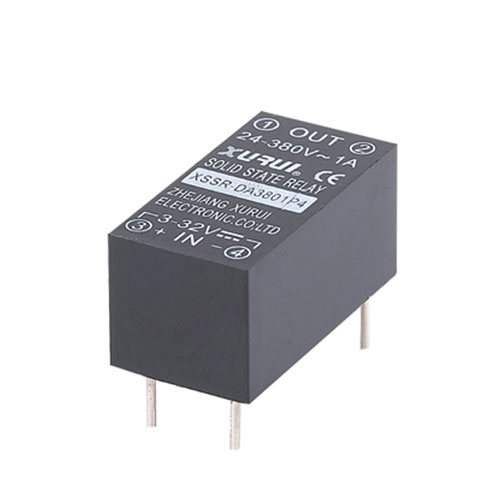
The XSSR-DD1101P4 is a DC-to-DC solid state relay with a control voltage range of 4-12VDC and a load voltage range of 5-110VDC. The control current is 6-30mA, and the reverse voltage is 1.5VDC. The guaranteed close voltage is 3.5VDC, and the guaranteed open voltage is 5-110VDC. The relay provides input-output electro-optic isolation or transformer isolation, with a safe isolation voltage higher than 2.5KV between the input, output, and baseplate.
| Parameter | Specification |
|---|---|
| Model | XSSR-DD1101P4 |
| Control Voltage | 4-12VDC |
| Control Current | 6-30mA |
| Reverse Voltage | 1.5VDC |
| Guarantee Close Voltage | 3.5VDC |
| Guarantee Open Voltage | 5-110VDC |
| Load Voltage | 5-110VDC |
| Output Current | 10A |
| Isolation Voltage | >2.5KV |
| Switching Type | DC-DC, zero current switching |
| Output Device | Power MOSFET |
Control Voltage and Input Compatibility
The 4-12VDC control voltage range makes the relay compatible with TTL and CMOS logic circuits, as well as standard industrial control signals. The input is constant-current controlled with an LED indicator, so you can see at a glance whether the relay is energized.
Load Voltage and Output Current
The 5-110VDC load voltage range covers a broad spectrum of DC applications, from low-voltage control circuits to higher-voltage DC power distribution. The 10A output current is sufficient for small motors, solenoids, valves, and heating elements within that voltage range.
Which Applications Suit a DC Solid State Relay?
The XSSR-DD Series is designed for industrial automation and control applications that require reliable DC switching. The relay's zero-current switching eliminates arcing and extends the life of the load. It is suitable for solenoid valve control, intermediate relay circuits, DC motor control, and heating element control in DC systems.
-
Solenoid valve control — quiet, spark-free switching for pneumatic and hydraulic valves
-
DC motor control — soft start and stop without contact wear
-
Heating element control — precise DC power modulation
-
Intermediate relay circuits — signal isolation and power switching
-
Industrial automation panels — reliable switching in PLC and DCS systems
Solenoid Valves and DC Motors
Solenoid valves and small DC motors benefit from the relay's zero-current switching. Unlike mechanical relays, the solid state device has no contacts to pit or weld, so it maintains consistent performance over millions of operations.
Heating and Lighting in DC Systems
DC heating elements and lighting circuits also benefit from solid state switching. The absence of mechanical wear means the relay can cycle rapidly without degrading, making it suitable for temperature control and dimming applications.
Answers to Common Questions About DC Solid State Relays
Can the XSSR-DD1101P4 switch AC loads?
No. The XSSR-DD1101P4 is a DC-to-DC relay, designed for direct current loads. For AC loads, a different model from the XSSR-DA series or a comparable AC solid state relay would be required.
What happens if the control voltage is reversed?
The relay has a reverse voltage rating of 1.5VDC. Reversing the control voltage beyond that limit can permanently damage the input circuit. Always verify polarity before connecting the control terminals.
How do I choose between natural cooling and a heat sink?
Use natural cooling for loads below 5A in cool, well-ventilated enclosures. For 10A loads, or in high-temperature or high-density installations, use a heat sink. For 40A and above, add forced air cooling.
What maintenance does the relay require?
The relay has no moving parts and requires no routine maintenance. Periodically check the mounting screws for tightness and inspect the heat sink for dust accumulation that could impede cooling. If a temperature switch is installed, verify that it operates correctly.
Request a Solid State Relay Configuration for Your Panel
The XSSR-DD Series solid state relay provides reliable DC switching with zero-current operation, 2.5KV isolation, and a 4-12VDC control range that is compatible with standard logic circuits. The XSSR-DD1101P4 from Xurui delivers 10A output at 5-110VDC, power MOSFET output for low on-state resistance, and LED status indication.
Contact Xurui for a solid state relay configuration assessment → their team can help you select the right model, heat sink, and protection scheme for your specific DC load and environmental conditions.