You're wiring a control panel or a PCB, and you need a switch that can route a signal to two different paths from a single lever. A Toggle Switch does that by moving a metal contact between fixed positions. The SPDT Toggle Switch MTS-103 from Xuruien uses an ON-OFF-ON configuration, which means the lever has three positions: one circuit on, both off, and the other circuit on. This article explains how the switching mechanism works, what the electrical ratings mean, and how to pick the right toggle for your application.
How Does an ON-OFF-ON Switch Route Signals?
The Three-Position Lever
An SPDT toggle switch has three terminals and a lever that moves through three detents. The center terminal is the common pole. The two outer terminals are the throws. In the ON-OFF-ON configuration, the lever connects the common pole to the first throw in one position, disconnects both in the center position, and connects the common to the second throw in the opposite position.
That center-off position is what separates ON-OFF-ON from ON-ON. In an ON-ON switch, the lever moves directly from one throw to the other with no off state. The MTS-103 includes the center off, which is useful when you need a neutral position — for example, in a motor control circuit where you want a stop state between forward and reverse.
Why SPDT Matters for Circuit Design
Single-pole double-throw switches are the workhorse of panel controls. They let you select between two inputs or route one input to two outputs without adding a second switch. In instrumentation, an SPDT toggle can switch a meter between two sensor channels. In telecom equipment, it can route a signal line between two paths. The MTS-103 brings that switching capability into a miniature package with a 0.25-inch mounting hole.
What Do the Electrical Ratings Tell You?
Contact Rating and Voltage
The MTS-103 carries a contact rating of 5A at 120VAC and 2A at 250VAC. That rating tells you the maximum current the contacts can switch without excessive heating or arcing. For low-voltage DC circuits, the switch also handles 28VDC at 5A. The dual AC ratings mean you can use the same switch in 120V and 250V systems, as long as you stay within the current limit for each voltage.
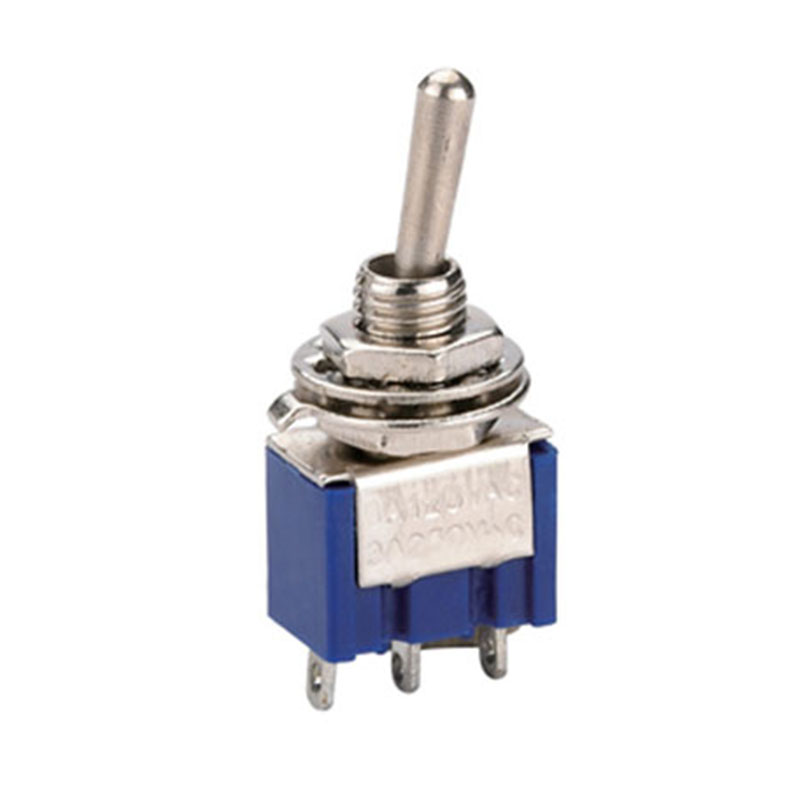
The switch function is SPDT ON-OFF-ON, with 3 pins and solder lug terminals. Solder lug termination is common for panel-mount switches where you're wiring discrete leads rather than inserting the switch into a PCB.
Mechanical and Electrical Life
The MTS-103 is rated for 50,000 mechanical cycles and 50,000 electrical cycles. Mechanical life is how many times the lever can be actuated before the mechanism wears out. Electrical life is how many times the contacts can switch a rated load before the contact surfaces degrade. The two numbers are often different — a switch might have high mechanical life but lower electrical life if the contacts arc under load. Here, both are rated at 50,000 cycles.
| Parameter | MTS-103 Specification |
|---|---|
| Contact form | SPDT |
| Switch function | ON-OFF-ON |
| Contact rating | 5A @ 120VAC / 2A @ 250VAC |
| DC rating | 28VDC, 5A |
| Mounting hole | 0.25 in. |
| Termination | Solder lug |
| Pins | 3 |
| Mechanical life | 50,000 cycles |
| Electrical life | 50,000 cycles |
| Contact resistance | 10 mΩ max |
| Insulation resistance | 1,000 MΩ min |
| Dielectric strength | 1,000 Vrms |
| Operating temperature | -25°C to +85°C |
| Actuator material | Brass, chrome plated |
| Body material | DAP |
| Seal | Epoxy seal at terminals |
How Does Sealing Affect Switch Reliability?
Epoxy-Sealed Terminals
The MTS-103 uses an epoxy seal at the terminals. That seal prevents flux, cleaning solvents, and moisture from entering the switch body during soldering and assembly. If you've ever soldered a switch and watched flux creep into the mechanism, you know why sealing matters. Flux residue inside a switch can cause intermittent contact, corrosion, and premature failure. The epoxy seal keeps the internal contacts isolated from the soldering process.
The body material is DAP (diallyl phthalate), a thermosetting plastic with good dimensional stability and electrical insulation properties. DAP resists the heat of soldering better than some thermoplastics, which helps the switch survive the assembly process without deforming.
Where Do Miniature Toggle Switches Fit?
Instrumentation, Telecom, and Medical Equipment
Miniature toggle switches show up in equipment where panel space is tight and the switch needs to be actuated by hand. Applications include telecommunications, instrumentation, networking, and medical equipment. In a rack-mounted instrument, the MTS-103 provides a manual override or mode selection without taking up the space of a full-size switch. In a medical device, the epoxy seal and 1,000 MΩ insulation resistance help meet leakage current requirements.
The MTS series also appears in guitar effects pedals, where the ON-OFF-ON configuration selects between two signal paths or bypass modes. The compact size and tactile feedback of the toggle make it a practical choice for pedal builders who want a mechanical switch rather than a soft-touch electronic control.
A Toggle Switch like the MTS-103 from Xuruien covers the electrical and mechanical requirements for these applications with a 50,000-cycle rating, a 0.25-inch mounting hole, and an epoxy terminal seal. The chrome-plated brass actuator and DAP body give the switch a durable feel and stable electrical performance.
What Comes Up Before You Specify a Toggle?
How do I choose between ON-ON and ON-OFF-ON?
Use ON-ON when you need to switch directly between two active circuits and never want an off state. Use ON-OFF-ON when you need a neutral position — for example, a motor control that must stop before reversing, or a signal routing application where you want to disconnect both paths. The MTS-103 is ON-OFF-ON, so it provides that center off position.
What's the difference between 5A at 120VAC and 2A at 250VAC?
The contact rating drops as voltage rises because higher voltage makes arcs harder to extinguish. At 120VAC, the switch can handle 5A. At 250VAC, the safe limit is 2A. If your circuit runs at 250VAC, size the switch against the 2A rating, not the 5A headline number. The MTS-103 is rated for both, so check your system voltage before specifying.
What does the epoxy seal protect against?
The epoxy seal protects the internal contacts from flux and cleaning solvents during soldering, and from moisture and contaminants during operation. If you're soldering the switch into a panel or PCB, the seal keeps flux out of the mechanism. If the switch is exposed to humid or dirty environments, the seal adds a layer of protection. The MTS-103's epoxy seal is applied at the terminals, which is where contaminants most commonly enter.
What mounting hardware does the switch need?
The MTS-103 mounts through a 0.25-inch hole with a threaded bushing. The mounting hardware is included, and the switch uses a 1/4-40 thread size. You'll need a panel thickness within the bushing's grip range, and you'll tighten the nut to secure the switch. The solder lug terminals accept discrete wires, so you're not limited to PCB mounting.
Let's Match a Toggle Switch to Your Panel
Share Your Voltage, Current, and Circuit Layout
A Toggle Switch should match your system voltage, load current, and switching logic — not the other way around. The SPDT Toggle Switch MTS-103 from Xuruien handles 5A at 120VAC and 2A at 250VAC, uses an ON-OFF-ON configuration with a center off position, and carries a 50,000-cycle mechanical and electrical life rating. The epoxy-sealed solder lug terminals protect the contacts during soldering, and the 0.25-inch mounting hole fits standard panel cutouts. If you're specifying a panel switch for instrumentation, telecom, medical, or audio equipment, send us your circuit requirements — we'll help you confirm the right configuration before you order.