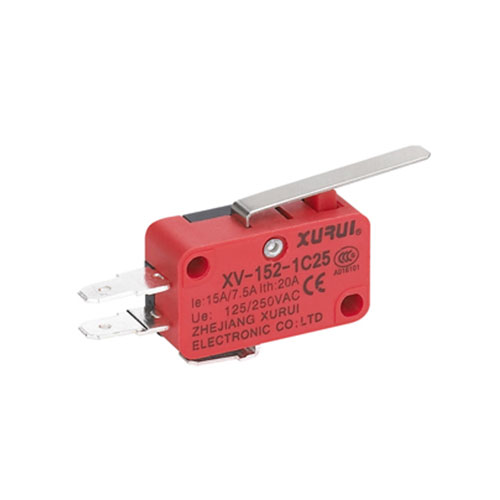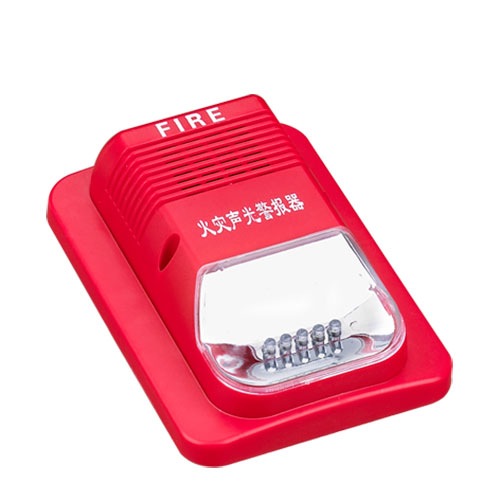
Mechanical life vs electrical life: why the switch that clicks can still be dangerous
A micro switch that has reached its electrical end of life will still click.
The lever-operated snap action mechanism does
not make or break contact; the internal moving contact bridge does.
The mechanism may outlast the contacts by an order of magnitude. On a switch used as a safety interlock in a microwave oven, this difference matters. The interlock circuit sees 5 to 10 operations per day, roughly 18,000 cycles annually.
At 100,000 electrical cycles, the contacts last over five years; at 1,000,000 mechanical cycles, the spring lasts 55 years. An operator may press the door closed and hear a click one day, but the main power circuit does not shut off because the contact resistance has drifted above the 100mΩ threshold that trips the control board`s safety monitoring circuit.
The XV-15 series specifies electrical life of 100,000 cycles minimum at 15A 250VAC (resistive load). The mechanical life is 1,000,000 cycles minimum (operating frequency: 600 operations per minute mechanical, 30 operations per minute electrical). The 1,000,000 mechanical cycles rating assures that the spring and actuator will not fatigue before the contacts wear out. The separate electrical life rating assures that the switching load is accounted for in the maintenance schedule.
| Life rating type | XV-15 series specification | Test condition |
|---|---|---|
| Mechanical life | 1,000,000 operations minimum (1M cycles) | Unloaded, 600 ops/min |
| Electrical life (resistive load, 15A-250VAC) | 100,000 operations minimum (100K cycles) | Rated load, 30 ops/min |
| Electrical life (resistive load, 7.5A-250VAC) | 200,000 operations minimum (200K cycles) | Reduced load, 30 ops/min |
Operating frequency matters because self-heating accumulates faster than ambient temperature alone would indicate. The standard electrical test at 30 operations per minute (one cycle every 2 seconds) leaves time for the contacts to cool between operations. A microwave door cycled quickly will not reach the test frequency, so field life often exceeds the minimum rating.
Action force, pre‑travel and differential travel: mapping the XV-15’s tactile feel
A basic micro switch’s mechanical characteristics determine how it feels to an operator and how much leeway a mechanical actuator has before the switch triggers. The XV-15 series with a straight lever (XV-15-1A25) specifies:
-
Maximum actuation force (OF): 200 g (1.96 N)
-
Minimum release force (RF): 50 g (0.49 N)
-
Maximum pre‑travel (PT): 1.2 mm
-
Minimum over‑travel (OT): 0.6 mm
-
Maximum differential travel (MD): 0.3 mm
The 200 g actuation force is moderate to firm but comfortable for a microwave door latch mechanism. Pre‑travel of up to 1.2 mm gives mechanical tolerance to accommodate variances in door hinge alignment during mass production. The over‑travel of 0.6 mm ensures that the switch remains actuated even if the door continues to compress the seal after initial contact. Differential travel of 0.3 mm means that once the switch operates, a small reverse movement—up to 0.3 mm—will cause it to reset. For a door latch, this low differential travel provides positive on/off hysteresis so the control logic does not see a rapidly oscillating signal at the trip point.
UL, TUV, and ENEC certifications: why the XV-15 series crosses borders
The XURUI XV-15 series micro switch carries certifications for three major markets: UL for North America, TUV for Germany (and widely accepted across the EU), and ENEC (European Norms Electrical Certification) for broader European acceptance. Appliances exported to the US require a UL‑listed or UL‑recognized switch. Coffee machines destined for Germany may require TUV approval. A switch that holds UL, TUV, and ENEC allows an appliance manufacturer to stock a single component for multiple market SKUs.
The basic characteristics listed as “UL, IP40” in the DirectIndustry entry mean the switch’s housing—a plastic casing with an IP40 ingress protection rating; small objects >1 mm cannot enter, but it is not protected against water spray. This rating is suitable for dry indoor appliances (microwaves, coffee machines, vending machines). For outdoor applications, a sealed version with a higher IP rating would be required.
The XURUI XV-15 series meets the UL61058 standard for switch testing, covering electrical endurance, dielectric withstand, and temperature rise.
How the CE and RoHS markings affect industrial equipment imports
CE marking indicates that the switch meets relevant EU safety, health, and environmental protection directives. RoHS compliance assures that the switch contains no more than the allowed maximum concentration of restricted hazardous substances (lead, mercury, cadmium, etc.). For a US‑based OEM selling coffee machines into Europe, both CE and RoHS are legal requirements, not optional certifications. The XV‑15 series carries both.
15A, 7.5A and derating: what the contact rating actually means for your product's wiring
The XV‑15 series, as indicated by its “(15A)” product name, has a maximum current rating of 15A at 125 VAC and 7.5A at 250 VAC for resistive loads, with a maximum inrush current rating (Ith) of 20A. This rating is defined for resistive loads (heaters, incandescent lamps). Inductive loads (motors, solenoids) require derating—typically 30‑50% of the resistive rating. A 15A‑rated switch switching a 5A inductive pump motor may under certain conditions last a shorter time than a 15A resistive load.
Derating also applies to DC loads. The same switch rated for 15A at 125 VAC is rated for only 0.3A at 250 VDC and 0.6A at 125 VDC. The arc formed when breaking a DC circuit does not self‑extinguish as readily as an AC arc, so the contact material and gap geometry must be derated for DC voltage.
For a microwave oven, the primary interlock switch switches a resistive heating element load and the control board power supply. The 15A rating at 125 VAC covers both loads with margin. For a coffee machine that uses a pump solenoid (inductive load), the derated rating should be applied.
Four applications where the XV‑15 series switches replace custom sensing solutions
The XV‑15 series is positioned as a general‑purpose basic switch for applications where a custom sensor would be over‑specified and the operating environment is dry and clean.
Appliance door interlocks. XV‑15 series switches are built into microwaves, washing machines, and refrigerators to detect open/closed door status for safety and function interlock.
They are often used in two‑switch redundant configurations—one normally open, one normally closed—so that a single contact weld does not bypass the safety circuit.
Vending machine product delivery sensors. XV‑15 series switches may be placed at the bottom of a snack machine‘s product column with a long lever actuator. When a product drops, the lever is deflected, and the switch signal increments the inventory count. The 1,000,000 mechanical cycle rating matches the expected service life of the vending machine.
Automotive pedal position sensing. An XV‑15 series switch may be used as a brake pedal position sensor in an industrial vehicle. The 200 g actuation force provides a distinct pedal feel that the operator notices.
Industrial counter sensors. A manufacturing line may use a micro switch with a roller lever actuator to count parts passing on a conveyor belt. The 30 ops/min electrical operating frequency is by the line speed. The 10‑55 Hz vibration tolerance (1.5 mm amplitude, no false operation) means the switch stays reliable on a vibrating conveyor frame.
The basic snap action mechanism that needs no power to operate
The XV‑15 series micro switch uses a snap‑action mechanism that requires no external power source to operate. Pushing the actuator forces a spring past its toggle point, which drives a moving contact bridge from the normally closed to the normally open position. The switching speed is independent of how fast the actuator is pressed; once the toggle point is passed, the spring completes the transition in a fixed time. This snap‑action behavior prevents contact chatter—the rapid make‑and‑break that would cause arcing and reduce electrical life.
The basic construction consists of a thermoplastic housing, a leaf spring actuator, a moving contact carrier, silver alloy contacts, and terminal pins. The housing provides mechanical support, electrical insulation, and dust protection (IP40). The moving contact is either silver‑cadmium oxide or silver‑tin oxide, depending on the switching load and cost target.
Initial contact resistance for the XV‑15 series is specified at 25 mΩ maximum, measured with a DC milliohmmeter. This low resistance minimizes power dissipated within the switch, preventing self‑heating from compounding the ambient temperature inside an appliance control cavity.
[Image: Exploded view of the XURUI XV-15 series micro switch showing the thermoplastic housing, leaf spring actuator, moving silver‑alloy contact bridge, and terminal pin assembly]
Pin plunger, lever and roller lever: matching the actuator to the application
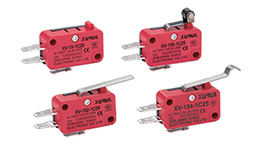
The XV‑15 series is offered with three basic actuator types:
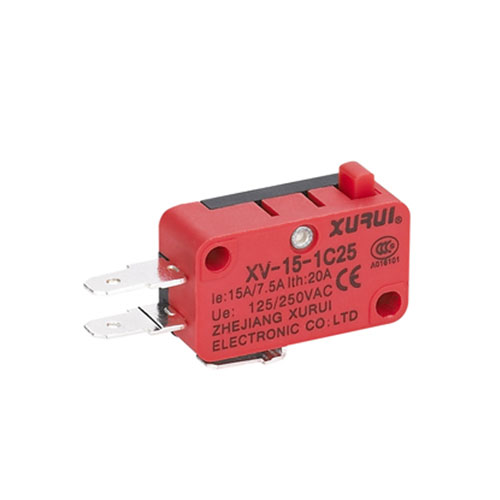
Pin plunger (direct acting). The actuator is a straight pin protruding from the switch housing. It is used when the moving part contacts the switch directly along a straight axis—for example, a microwave door latch pushing the pin plunger.
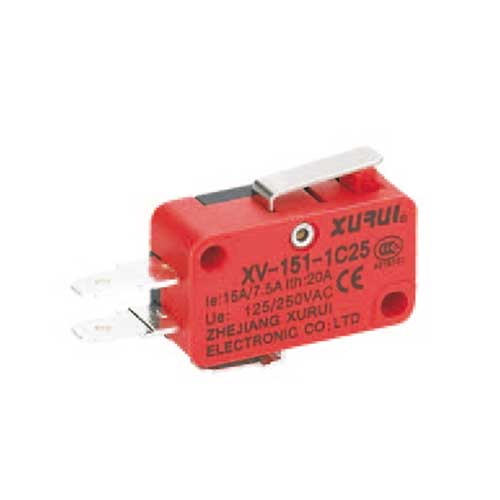
Lever. A formed metal lever extend from the switch housing, providing a larger target surface for the actuating cam or door latch. An operator may change the actuation force and travel by adjusting the lever length.
Roller lever. A roller mounted on the end of the lever reduces friction when the actuator slides along a cam surface. A vending machine product delivery sensor uses a roller lever so the dropping product glides off the lever rather than snagging.
A custom lever may also be added; some XV‑15 series switches are supplied without a lever, and the OEM adds its own actuator.
Three things to test when qualifying a micro switch for a new design
First: Check the electrical endurance at the actual load, not the nameplate rating
A lamp load generates a high inrush current that may exceed the steady‑state rating by 10‑15x, which can weld contacts closed. Run the switch at the intended load for 50,000 cycles (or at least 10% of the rated electrical life). After the test, measure contact resistance with a milliohmmeter. Reject the switch if the resistance exceeds 100 mΩ.
Second: Verify the over‑travel in the mechanical assembly
Design the actuator such that it continues to move beyond the switch’s operating point by at least the rated over‑travel (0.6 mm minimum for the XV‑15 series). For a microwave door, that means the door seal must compress further after the switch trips. If the actuator stops before reaching over‑travel, the switch may not maintain contact closure over the product‘s life if the door gaps change.
Third: Run the vibration test on the actual mounting bracket
The switch specified for 10‑55 Hz, 1.5 mm amplitude (no false operation) is tested on a rigid fixture. When mounted on a thin sheet metal bracket resonant at a lower frequency, the switch can false‑trigger. Test the assembled bracket on a vibration table before finalizing the design.
How the XV‑15 series fits into Xurui Electronics’ micro switch portfolio
Zhejiang XURUI Electronics Co., Ltd., founded in 2002, is a manufacturer of micro switches, solid‑state relays, limit switches, foot switches, toggle switches, and other industrial control products. Their products are widely distributed across the globe, with authorized agents and after‑sales service centers in South Korea, Turkey, Egypt, Italy, and other regions.
The XV‑15 series sits in the basic micro switch segment of the product line, positioned alongside the larger XZ‑15 industrial limit switch series (for heavy‑duty applications) and the XZ‑9 (metal‑housed) limit switches for high‑impact environments. XSS‑5 switches and other specialty micro switches round out the portfolio.
XV‑15 series switches are rated for 15A at 125/250 VAC, feature a standard pin plunger with optional lever/roller lever actuators, and hold UL, TUV, ENEC, CE, and RoHS certifications for appliance, vending, automotive, and industrial counter applications.
For a micro switch that prevents hidden circuit failures with a separate 1,000,000 mechanical cycle rating and an electrical life rating of 100,000 cycles at 15A 250 VAC, the XURUI XV‑15 series delivers snap‑action switching, 200 g actuation force, 25 mΩ contact resistance, and worldwide certifications.
[Request a quote from Zhejiang XURUI Electronics Co., Ltd.]
Contact XURUI Electronics with your switching load (voltage, current, AC/DC, resistive/inductive) and required actuator type (pin plunger, lever, or roller lever) for a certified XV‑15 series sample quotation.