You’re specifying a position sensor for a coal conveyor or a chemical plant hoist, and the location is classified as explosive. A standard limit switch with a mechanical contact would arc inside its housing, and that arc could ignite the surrounding gas or dust. A Mercury Switch designed for explosion-proof service solves that by sealing a bead of liquid mercury inside a glass envelope, so the switching action happens in an inert environment with no open arc. The BLY1-5/111 from Xuruien pairs that liquid-contact element with a high-strength aluminum alloy flameproof enclosure, rated IP67 and 2A at 127VAC/110VDC. This article explains how the liquid contact eliminates the ignition risk, what the flameproof housing contributes, and what to verify when you’re selecting a tilt switch for a hazardous location.
What Makes the Switching Element Different?
Liquid Mercury as a Moving Contact
A conventional limit switch uses a mechanical plunger or lever to press two metal contacts together. When those contacts separate under load, an arc forms across the gap. In a hazardous area, that arc is the ignition source—it only takes a small spark to ignite a flammable gas mixture.
A Mercury Switch eliminates the mechanical contact gap. The switch body is a sealed glass envelope containing a small pool of liquid mercury and two electrodes. When the switch tilts, the mercury flows to bridge the electrodes, completing the circuit. When it tilts back, the mercury flows away, and the circuit opens. There’s no mechanical contact to wear, no spring to fatigue, and no open arc at the switching point because the mercury makes and breaks the connection inside the sealed envelope.
Response Time and Contact Resistance
Because the mercury moves as a liquid, the switching action is fast and the contact resistance is low. The BLY1-5/111 holds contact resistance at ≤200mΩ, which keeps voltage drop minimal and heat generation low at the 2A rated current. The operating angle is 30°, so the switch changes state when the housing tilts past that threshold. That angle is wide enough to avoid false triggering from vibration, but narrow enough to detect a meaningful position change.
| Parameter | BLY1-5/111 |
|---|---|
| Voltage rating | 127VAC / 110VDC |
| Current rating | 2A AC / 2A DC |
| Operating angle | 30° |
| Contact form | 1NC + 1NO |
| Protection degree | IP67 |
| Contact resistance | ≤200mΩ |
| Dielectric withstand | ≥2500VAC |
| Insulation resistance | ≥100MΩ |
| Operation frequency | ≤600 times/hour |
| Cable entry | Φ14–19mm |
| Operating temperature | -25°C to 80°C |
| Housing | High-strength aluminum alloy, flameproof |
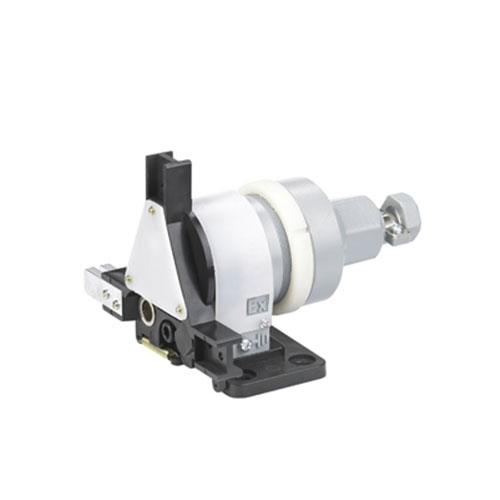
How Does the Flameproof Housing Contain an Internal Fault?
Aluminum Alloy Enclosure and Flame Path
The Mercury Switch element is mounted inside a high-strength aluminum alloy enclosure. That enclosure is not a simple box—it’s a flameproof (explosion-proof) housing designed to contain an internal explosion without allowing the flame to propagate to the surrounding atmosphere. The joint between the cover and the body forms a flame path: if a spark or arc occurs inside, the hot gases expand through the narrow gap and cool below the ignition temperature of the external gas before they escape.
The aluminum alloy construction provides the mechanical strength to withstand the internal pressure of an explosion and the impact resistance to survive a mining or chemical plant environment. The IP67 rating seals the enclosure against dust and water ingress, so the internal components stay dry and the flame path stays clear.
Temperature and Cable Entry Control
The operating temperature range is -25°C to 80°C. That range covers the ambient conditions in underground mines, oil storage facilities, and chemical plants. The cable entry accepts cables from Φ14–19mm, and the entry is sealed to maintain the IP67 rating and the flameproof integrity.
The ≤600 operations per hour rating reflects the switch’s intended duty: position detection and limit protection, not continuous cycling. In conveyor run-off or hoist over-wind protection, the switch operates only when the condition occurs, so the hourly rate stays well below the limit.
Where Does a Tilt Switch Fit in Hazardous Operations?
The BLY1-5/111 is used in mines, oil depots, chemical plants, and other locations with flammable gas, dust, moisture, or corrosive media. The specific applications include mine shaft hoist car parking and over-wind protection, pusher and dumper position detection, coal bunker gate signals, and belt conveyor run-off and belt-break protection .
In each of those applications, the switch detects a mechanical position or a deviation from normal operation. When the conveyor belt runs off its track, the switch tilts and sends a signal to stop the drive. When the hoist car reaches the end of its travel, the switch tilts and cuts the power. The liquid-contact element makes that signal reliable in an environment where a mechanical contact would arc or corrode.
What Should You Check Before Selecting a Tilt Switch?
How do I match the contact form to my control circuit?
The BLY1-5/111 provides 1NC + 1NO contacts. That combination covers both a normally closed stop circuit and a normally open signal circuit in one device. If your control logic needs the switch to open a circuit on tilt, the NC contact handles that. If it needs to close a circuit to trigger an alarm, the NO contact handles that. Confirm which contact your panel uses for the safety function and wire accordingly.
What voltage and current does the switch accept?
The voltage rating is 127VAC or 110VDC, and the current rating is 2A on either AC or DC. Match those ratings to the control circuit. If the circuit voltage exceeds 127VAC, the switch is not rated for that application. If the current exceeds 2A, an interposing relay is required to carry the load.
What operating angle and mounting position do I need?
The operating angle is 30°. The switch changes state when the housing tilts past that point. Confirm that the mechanical movement you need to detect produces at least a 30° tilt at the switch mounting point. If the movement is smaller, the switch won’t trigger. The installation position and the direction of tilt also determine which contact opens and which closes.
What maintenance does the switch need?
The sealed glass envelope and the flameproof housing have no user-serviceable parts. Inspect the enclosure for mechanical damage or corrosion during scheduled maintenance. Check the cable entry seal for tightness and the flame path surfaces for debris or paint buildup. Verify that the mounting bolts are secure and the switch operates at the intended tilt angle.
Straight Answers on Explosion-Proof Tilt Switches
What’s the difference between a standard limit switch and an explosion-proof one?
A standard limit switch has an open contact mechanism inside a general-purpose enclosure. An explosion-proof switch has a flameproof enclosure designed to contain an internal explosion and prevent it from propagating to the surrounding atmosphere. The BLY1-5/111 combines the flameproof housing with a liquid mercury contact, so the switching element itself doesn’t produce an open arc.
Can the switch be used in dust environments as well as gas?
The BLY1-5/111 is suitable for environments with combustible gas or dust, moisture, and corrosive media. The IP67 rating seals the enclosure against dust and water, and the flameproof housing contains an internal fault. Confirm the specific dust group and temperature class against the installation’s classification before specifying the switch.
Why use mercury instead of a mechanical contact?
A mechanical contact opens and closes with a visible gap where an arc can form. A mercury contact makes and breaks the circuit inside a sealed envelope, so there’s no open arc at the switching point. That eliminates the primary ignition risk in a hazardous area and also removes the contact wear that a mechanical switch experiences over time.
What is the switch’s response time?
The mercury moves quickly when the switch tilts, and the response time is typically within 1 microsecond . That speed is fast enough for position detection and safety tripping in conveyor and hoist applications, where the switch needs to signal a fault before the mechanical movement causes damage.
Let’s Match a Tilt Switch to Your Hazardous Location
Share Your Voltage, Angle, and Environment
A Mercury Switch for explosion-proof service should match your control voltage, required tilt angle, and area classification—not the other way around. The BLY1-5/111 from Xuruien pairs a sealed liquid-contact element with a high-strength aluminum alloy flameproof housing, rated IP67 and 2A at 127VAC/110VDC, with a 30° operating angle and 1NC+1NO contacts. It’s built for mine hoists, conveyor run-off protection, and chemical plant position detection in flammable gas or dust environments. If you’re specifying a tilt switch for a hazardous area, send us your voltage, angle, and environment — we’ll help you confirm the right configuration before you order.